1、 Principle and Implementation of Mainstream Speed Control Methods 1. Voltage speed regulation (analog speed regulation, commonly used for 3-pin fans) Core principle: Based on the positive correlation between the speed of a brushless DC motor and the input voltage, the current is adjusted by changing the amplitude of the winding input DC voltage, thereby changing the stator magnetic field strength and controlling the rotor speed. Implementation method: Linear voltage regulation: LDO and linear regulator are used in series for voltage regulation. The lower the voltage, the slower the speed. The structure is simple, but the low-speed efficiency is low and the heat generation is high. Resistance voltage regulation: potentiometer/variable resistor voltage division, low cost but poor accuracy, high energy loss, suitable for simple scenarios. Key features: Advantages: Simple circuit, low cost, no need for complex control chips. Disadvantages: Significant torque attenuation at low speeds, narrow speed range (usually 5V – 12V), linear voltage regulation prone to overheating, not suitable for high-precision scenarios.
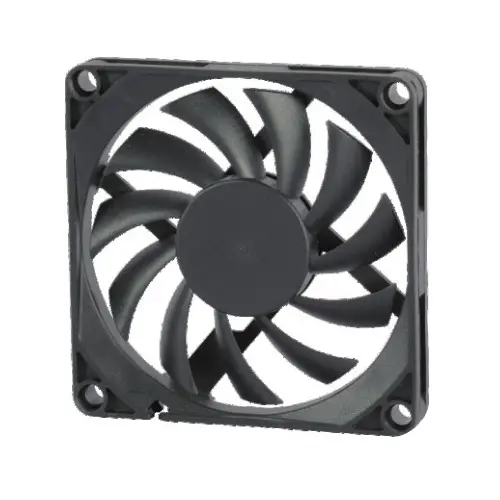
2. PWM speed regulation (pulse width modulation, mainstream 4Pin fan) Core principle: A fixed power supply voltage (such as 12V/24V) is used to control the average current of the winding through the duty cycle of high-frequency square waves (the proportion of high-level to total cycle), effectively adjusting the average voltage and achieving stepless speed regulation. Implementation process: Signal input: The controller outputs a fixed frequency (20kHz – 50kHz, commonly 25kHz) PWM square wave, which is transmitted to the fan drive board through the PWM line (usually blue line) of the 4Pin interface. Switch control: The power MOSFET of the driving board is turned on and off at high speed according to the PWM signal. When it is turned on, the winding is supplied with full voltage, and when it is turned off, the energy stored in the winding is released through the freewheeling diode to avoid damage to the components caused by reverse electromotive force. Speed correlation: duty cycle of 100% → continuous power on, fan at full speed; Duty cycle 50% → average current halved, speed approximately 50% of rated; A low duty cycle (<10%) may cause difficulty starting or stalling. Key features: Advantages: High speed regulation accuracy (adjustable duty cycle from 10% to 100%), stable low-speed torque, high efficiency (saving more than 30% energy compared to linear pressure regulation), fast response, suitable for temperature control linkage. Disadvantage: It requires the integration of PWM drive and control circuits, which is more expensive than voltage speed regulation.

